Friday, July 20, 2012

GILGAMESH!

What with one thing or the other, it's been some time since I last posted. Let me rectify that.
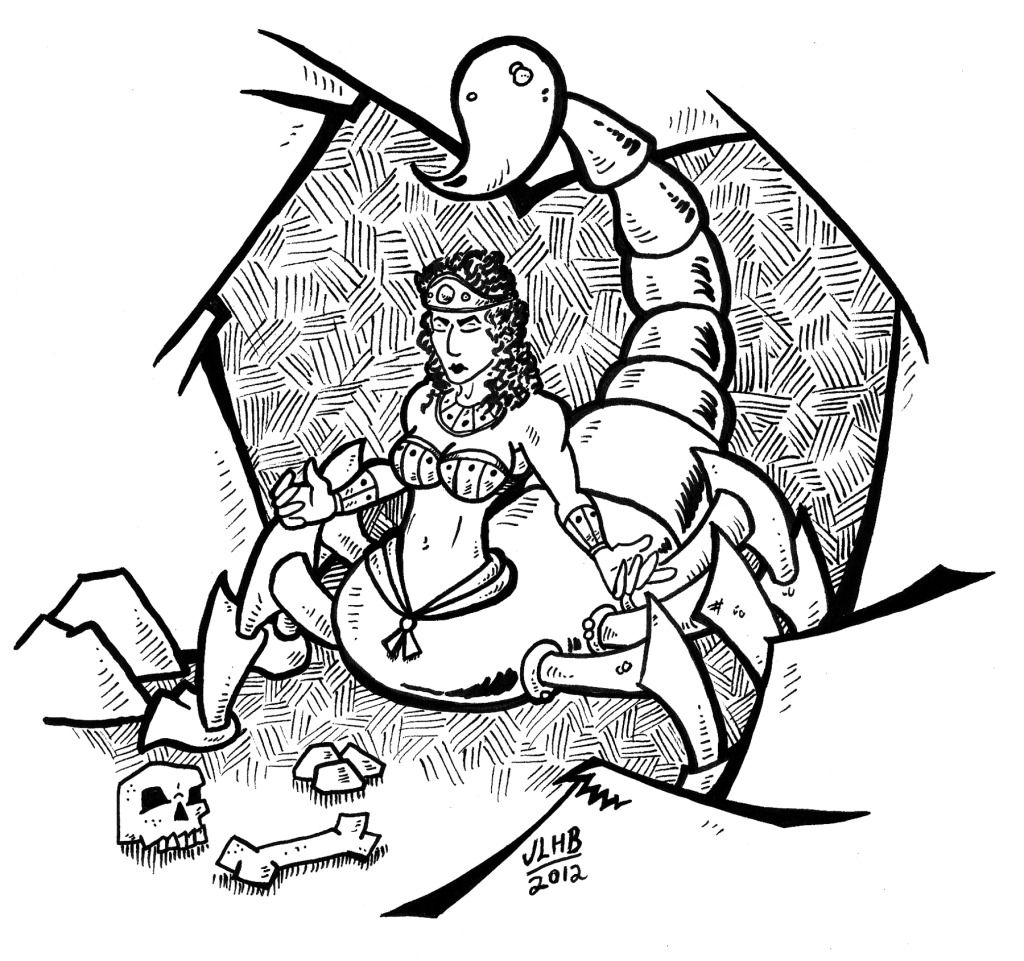
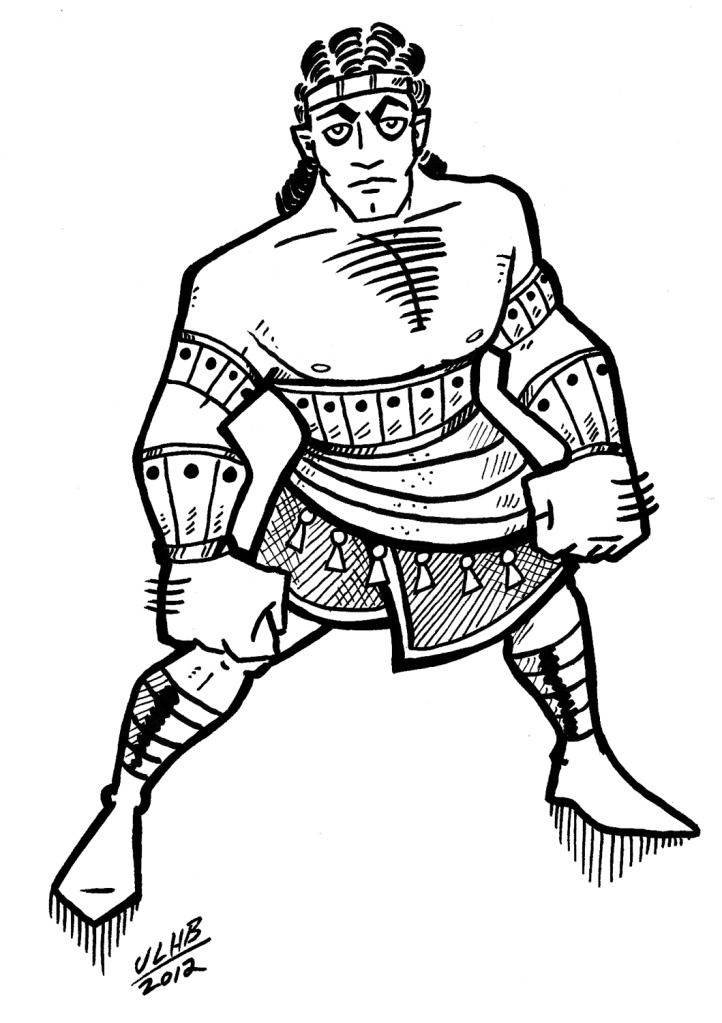
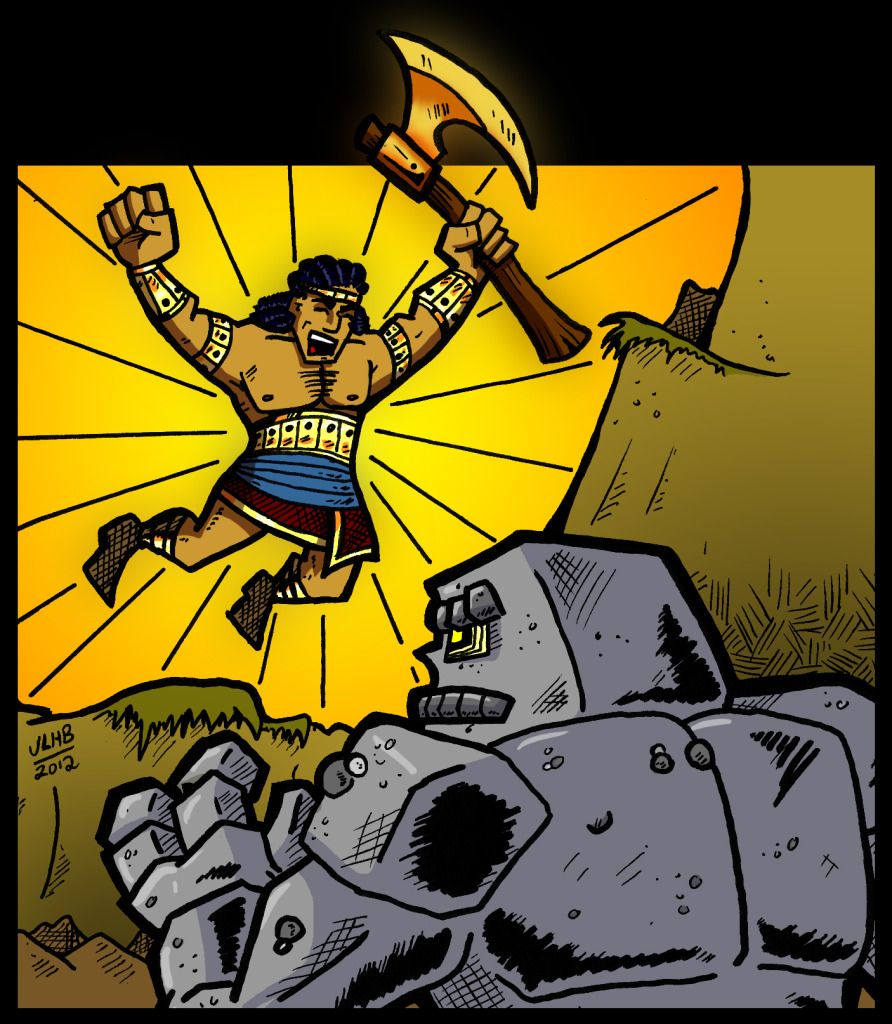
My Leopard Women of Venus co-conspirator Leighton Connor is finishing up his latest project for Hex Games. It's an epic adventure of mythic fantasy called GILGAMESH! (All caps, with the exclamation pint!) He asked me to do art for the project, and I was happy to oblige.

Gilgamesh vs. the Rock Man!

A dastardly scorpion woman!

Mighty Gilgamesh, king of Ururk!

GILGAMESH! should be available for purchase by the end of the month. GILGAMESH!


Friday, February 24, 2012

What I want my son to learn by playing D&D


I recently started playing BECMI Dungeons & Dragons with my 11-year-old son. I'm trying to give him the whole “Redbox” experience—searching room after room by torch-light, mapping as you go, listening for skeletons and goblins. I want Bargle to piss him off as much as he did me.

Perhaps more importantly, there are several life lessons I want the boy to learn through D&D.

Math!
This is the obvious one, but it's still true. I'm no calculus whiz, but nothing taught me to add and subtract columns of number quickly and accurately like shopping for equipment for my D&D characters. That's not even touching on the math and geometry required for combat and miniatures movement.

Be a Gracious Winner and a Good Loser
Sportsmanship is a difficult lesson to learn these days. We live in a poor section of town, so there's not much in the way of organized sports, nor does his school offer much. And let's face it, I'm a D&D nerd, I'm not big on sports anyway. But even when I was a kid, I had Sports Billy, Fat Albert, and other shows to teach me about good sportsmanship.

No so much any more. I've heard the banter on Xbox live. I've been on Ventrillo on failed raids in WoW. Sportsmanship, grace, and humility are rare traits.

So, I'm hoping to teach the boy those qualities through D&D. When you succeed, good job! You should be proud, but don't brag (unless, you know, you're roleplaying a braggart, but one thing at a time, okay?). Pride leads to hubris, which leads to failure. And when you DO fail, you get up and try again. Don't brood, don't sulk, don't get angry. It's a game. Your elf was eaten by an ochre jelly? Roll up a dwarf and try again. The fun in in the playing.

Fun is independent of Success or Failure
This goes along with the above lesson. It doesn't matter if you saved the princess and slew the minotaur, or if your party got wiped out by the first batch of kobolds. What matters is that you had fun. More often than not, massive failures make for better stories than victories. This is the “Call of Cthulhu Corollary.”

The Impermanence of Things
This is the “Rust Monster Rule.” Nothing lasts forever. Sometimes you're going to loose things you love. You have to learn to let go of material things. Sure that +5 Vorpal Sword is nice, but one magical armadillo can destroy it forever in six rounds. You gotta just let it go.

Experience is The Most Important Thing
Sure, gold is nice, but when it comes right down to it, it's the experience and the things you learn that let you grow as a person.

Monday, February 20, 2012

The Rumor Mill -- Using rumors to develop new PCs.

I've recently started playing a retro-clone game called “Adventurer Conqueror King” from Autarch. It's a great new take on old-style D&D, and I'll review it more in-depth later. Right now I want to share something I did in our first session as an example of what you can do to quickly build depth into new characters, only five-minutes into the game.

So we've got a shiny new group of adventurers. They area all currently live and work in the same geographic location (in this instance, a small town) and, if not friends, they have at least heard of each other. I take all the PC names and write them on slips of paper. I shuffle the names up and pass them pack to the players. I have the players look at the names but don't show anyone else. Any player who get's the name of his own PC should swap with the player next to him until everyone has the name of a PC that isn't theirs.

Now we go around the table. I look to Destiny's player.
GM: “Whose name do you have Destiny?”
Destiny's player: “Valmar's”
Valmar is a Neutral Human Mage.
GM: “Tell me a rumor that everyone has heard about Valmar.”
Destiny smiles; Valmar looks nervous.
Destiny: “Back when he was a teenager, Valmar killed his uncle with black magic.”

Now this rumor is established! People have heard this rumor, it exists, and there's nothing anyone can do about it. But, we turn to Valmar's player.

GM: “Valmar, is this rumor true? And if not, what's the true story?”
Valmar (lighting up): “I DID kill my uncle with magic, but what nobody knows is that he was killed then resurrected by an evil necromancer. He was a zombie when I blasted him!”

Excellent! Now, not only do we know a bit more about Valmar's past, we have an idea about what the community thinks about him, plus we have the seeds for a new NPC, an evil Necromancer with ties to Valmar's family.

I reward both players. Destiny gets 250xp for creating the rumor. Valmar gets 250 for accepting and/or clarifying the rumor. If they were higher level, I'd give them more XP. If we were playing QAGS, I'd give them Yum Yums. If FATE, Fate Chips. Reward your players in whatever currency works best for your game.

We continue around the table this way. Eventually every player should be rewarded twice. Once for creating a rumor, and once again for clarifying a rumor about their own character.

This worked great for my group, and within 5 minutes, before the game had even started, we had personality quirks and vague background stories already established for a fresh batch of PCs.

Give this technique a try with your own groups and let me know how it works!

Sunday, October 9, 2011

Themysciran Heritage for the Smallville RPG

My game group has been quite enjoying the Smallville RPG from Margaret Weis Productions. After a couple sessions, my wife has become enamored of the idea of playing a Themysciran. Themyscira, of course, is the native home of Wonder Woman. I like the idea, too, so I banged out a new Heritage Distinction. Give it a look-see!

Themysciran Heritage
Themyscira (also known as Paradise Island) is an island nation in the Mediterranean Sea. Its all-female population is descended from the Greek gods and are known in legend as the Amazons. Thousands of years ago, the Amazons grew tired of the corrupt and warlike nature of “Man's World” and hid their nation with powerful magics and weird science. After centuries of isolation, Themyscira has recently begun to send emissaries to the outside world, curious to discover if the world is ready for Amazonian enlightenment. Divine ancestry and specialized training have given Themyscirans powers that rival Kryptonians and Martians, but they lose their powers if tied up or otherwise bound.

d4: Earn a Plot Point whenever you Choose to show open disdain for or ignorance of “Man's World.”

d8: Add a d6 to the Trouble pool to use a Special Effect from a connected ability you do not have.

d12: Spend a Plot Point to increase your Insecure or Injured Stress pool.

Connected Abilities: Flight, Regeneration, Super Senses, Super Speed, Super Strength

Limits: Binding

Sunday, September 25, 2011

"New and Magic land" -- an RPG about pioneers

I started this RPG last year, then forgot about it. The 500 Word RPG Challenge last week reminded me of it, and I decided to dig it out again. I spent the day polishing it up. It's not done yet, but this document covers all the mechanics pretty well and should be more than sufficient for playtesting. Check it out, and tell me what you think!

PDF at Google

New and Magic Land
By Joshua LH Burnett (c) 2011

New and Magic Land is a story game that follows the lives of a group of settlers as they struggle to survive their first year in the frontier. By default, the game is set in the American frontier sometime in the 19th century, but there is no reason the game cannot be set in a different time and place. The settlers could be exiled elves trying to eke out an existence in the orcish wastelands, star-faring colonists terraforming a savage new planet, or any other setting where a small group must carve out an existence in hostile territory.

One player will serve as the Gamemaster (GM), and the other players take on the rolls of settlers. The PCs are not the only settlers in the story. There are numerous other settlers with them. Some NPC will form important relationships with the PCs, others will remain nameless extras. The PCs, however, are the most narratively “important” settlers in the group. They are the stars of the show.

Thursday, September 22, 2011

Lemurian Commission

Behold!  A dangerous Lemurian warrior complete with armor and sonic pole-arm!
Commissioned for Thunderstep's gonzo steampunk campaign.
Fun commission. I liked how the colors turned out on this one. Enjoy!

Molemen & Missives (a 500 word RPG)

Ryan Macklin recently set a  "Flash Game Design Friday" challenge. To quote:

I’m going to give you three mechanical ingredients. You use at least two:
  • Two dice that you don’t add together
  • A single token that sometimes is and sometimes isn’t on your character sheet/possessed by the player
  • a countdown mechanic (whatever the hell that means)
Write a game that takes 500 words or less to explain, which should include a hint of setting.


I chose the first two ingredients and took some inspiration from More Information than You Require to create... 

Molemen & Missives
By Joshua LH Burnett
with apologies to John Hodgman

You are a Moleman, a disgusting yet refined denizen of the Deep Down Dark. You have sharp claws and teeth, acidic saliva, and luminescent mucus. You also have a great love of social philosophy, powdered wigs, and pantaloons. You are part of a committee dedicated to solving problems affecting your hideous community.

The Mole Master
This is what we call the GM in this game, just because.

The Making of a Moleman
Give yourself a Name. Typical Molemanic names include Theopolis, Henrietta, and Hsss'kkk'thiix.

Write down your Vocation, which is your job in the community. Examples include: Fungus Wrangler, Mucus Sculptor, or Grub Knight.

Take 10 points and divide them between the four core Values of the Molemen.

Industry for tasks that involve creation or hard labor.

Learnedness for tasks that requires education or study.

Vigilance for tasks that involve forethought or the defense of your community.

Refinement for tasks that require charisma or style.

You have a Resolve score equal to the sum of your two highest Values. You lose Resolve when you lose Debates. Resolve refreshes at the beginning of each game.

The Wig
Molemen love to talk. Within a committee, it would be quite easy for each Moleman to to try to talk over his fellows, and nothing would get done. Hence, the Wig. Each committee has one wig. Only the Moleman wearing the wig may talk. Once he was spoken, he must give the wig to another committee member. It is considered rude to ask for the wig next instead of patiently waiting your turn. Wigless Molemen can still communicate through sign language or charades, but this is considered gauche. Written communication in the form of long, passionate missives, letters, and pamphlets are quite acceptable and actively encouraged!

Debates
Molemen characters are free to do whatever they want until someone tells them they can't. When there's a conflict of interests between two parties, we got ourselves a Debate. Resolve debates as such:

1) Set the stakes.

2) Each side describes what they are doing and gathers a number of d10 equal to the relevant Value.

3) If the opposing side is the Molemaster, he will chose 1d10 to 7d10, depending upon the difficulty.

4) Roll!

5) If you have multiples of the same number, add 1 to the result for each extra die. (If you rolled three 6s, your result would be 8.)

6) If your action involved your Vocation, you can gather some of your dice and reroll them once.

7) The highest result wins!

8) The defeated side loses a point of Resolve, plus 1 more for each multiple the opposition rolled.

9) A Moleman with 0 resolve is out of the game. He's too dejected, depressed, or devoured to continue.

10) Other Committee members can help you in debates. They describe how they are helping you and add 1d10 to your pool. If you lose, your helpers lose resolve too!

I've also made a swanky PDF of the game!